
I Can’t Go for That (No Can Do)
Sacred Boundaries, Love, and What Is Ours to Tend
Lately, I’ve had a Hall & Oates song running through my head: I Can’t Go for That (No Can Do).
I was born in 1980, so this song that came out in 1981 has somehow been floating around the soundtrack of my life for almost as long as I’ve been alive. As my husband, Chihiro, put it, the music video feels less like 1981 and more like a Saturday Night Live parody of 1981. And beneath all that glorious '80s excess I'd suddenly heard something I never noticed before: a surprisingly clear teaching on boundaries.
There is something wonderfully uncomplicated about it. No carefully constructed multi-step process for discerning the perfect boundary. No elaborate justification. No case to build.
Most of the time my body already knows. There is a contraction, a dissonance, a clear internal no. And increasingly, I am learning to trust that embodied knowing before my mind begins negotiating with it, explaining it away, or convincing me that because I could do something, I therefore should.
I can’t go for that. No can do.
There is also a lightness in that clarity that I am increasingly drawn to. I don’t want boundaries to become another hard thing I have to perfect. I want them to help me move through life more lightly, more available for what is actually mine.
My spiritual brother, Transformative Educational Leadership (TEL) Alum and TEL Master Facilitator, Mychal Mills, first introduced me to Ma’at, the ancient Egyptian goddess and embodiment of truth, justice, harmony and balance. In the Egyptian weighing-of-the-heart tradition, the heart was weighed against the feather of Ma’at, a symbol of truth and right relationship.
That image has stayed with me: What would it mean to commit to moving through life with a heart as light as a feather?
The more complex my life becomes, the more I understand that sacred boundaries are part of how I put down unnecessary weight. I don’t want boundaries to make me harder. I want them to help me become lighter, more available for what is actually mine to love and tend.
And these days, I need that practice deeply.
Some of you know that my mother’s health has changed profoundly. Our family is accompanying her through significant neurological and cognitive changes while also tending the increasingly complex care of both of my aging parents. At the same time, I am a mother and wife. I lead an organization I love. I am writing, researching, teaching and speaking. My family is also deeply connected to a young school rooted within a spiritual community that matters enormously to us and is itself still becoming.
There is so much I love. There is also so much I can see.
And I am learning, sometimes painfully, that what I can see is not necessarily what I am called to carry.
Sovereignty Requires Boundaries
In June, I wrote about what I have come to understand as the true meaning of sovereignty. For me, sovereignty is not independence or control. It is the conscious stewardship of our life force toward what has truly been entrusted to our care: our deepest relationships, responsibilities, practice and sacred work.
I still believe that deeply. But lately I have been discovering the next layer: If sovereignty helps me know where my life force belongs, sacred boundaries are how I protect its passage there.
Knowing what matters is one thing. Living accordingly, especially when so much else is asking for our attention, is another. One of my lifelong edges is that I notice things. I notice what hurts, what could be stronger, the person who needs support, the system that isn’t functioning, the relationship that needs tending, the place where greater care, clarity or consciousness might make a difference.
Perhaps you know this pattern too. We see something, we care, and almost imperceptibly, caring becomes responsibility: I noticed it, therefore I should do something about it.
But lately another sentence has been teaching me: That is information, not an assignment.
I can notice without taking possession. I can care without intervening. I can love without carrying.
That last one may be the hardest. Many of us have been taught, explicitly or implicitly, that love means taking something on. Love means fixing. Love means helping. Love means being available. Love means staying close. Love means saying yes.
But I am discovering that love can also sound like: I care deeply, and this is not mine.
And discernment does not always arrive as a thought. Sometimes it arrives first in the body as expansion or contraction, resonance or dissonance, a quiet yes or an unmistakable no. Part of sacred boundaries, for me, is learning to listen before I override that knowing.
Walking Out and Walking On
I’ve also been returning to Margaret Wheatley and Deborah Frieze’s invitation in Walk Out Walk On: there are moments when we need to withdraw our energy from what is no longer life-giving and walk toward what is.
That distinction matters because sacred boundaries are not simply about what we refuse. They help us discern where life is actually asking for our participation.
Where am I being called to walk toward? What deserves the finite hours of this one precious life? What relationships, responsibilities and possibilities become more fully alive when I stop trying to fix broken systems?
Sometimes a boundary is simply a no. But the deepest no is usually protecting a yes.
The purpose of the boundary is not the boundary. The purpose of the boundary is to keep us available for what we love most.
Love Does Not Cancel Complexity
As the school year begins, I’ve been thinking about educators too. We often rush toward the positive reframe: Remember your purpose. Remember how lucky you are. You get to teach. And yes, teaching is sacred work. I still carry deep love for my years in the classroom and for the relationships I built with students. But another truth deserves room alongside that one: you can love the work and still feel overwhelmed by what it asks of you.
I remember how much of myself teaching required, and how necessary summer became as a time to recover and return to myself. There was nothing wrong with the complicated feelings that came with going back. There is a difference between finding meaning in what is hard and pretending that hard things are not hard.
Sometimes we reach for gratitude before we have honored what is actually present. Sacred boundaries invite something different: listening honestly to the body, acknowledging exhaustion or apprehension without shame, and discerning what will allow us to remain in relationship with the work without abandoning ourselves within it.
Love does not cancel complexity.
Belonging Without Carrying the Whole
I am learning this in community too. There are people with whom resonance comes easily. Others stretch us. There are places where our gifts are genuinely needed and places where our involvement may create more entanglement than benefit. There are things we may see clearly that are simply not ours to resolve.
And I am learning that belonging does not require participating in everything.
I do not need confidence in everyone in order to belong. I can choose closeness with some people and loving distance with others. I can recognize limitations without appointing myself to repair all of them. I can participate wholeheartedly without carrying the whole.
I can love a place without feeling the need to carry a place. This feels different from disengagement. It is participation with discernment.
Perhaps one sign that a boundary is true is what happens after we honor it: not hardness, but greater spaciousness. We become lighter because we are no longer carrying what was never ours.
A Blessing for Boundaries
Recently, my spiritual sister Aija Simmons, a TEL alum and one of our TEL Master Facilitators, shared a beautiful blessing on boundaries with our community.
Those of you who have traveled with me for a while know how deeply John O’Donohue’s writing has accompanied my life. I have shared his writing on thresholds before, and his blessings have also become part of how we mark meaningful transitions within TEL.
These two lines especially stayed with me:
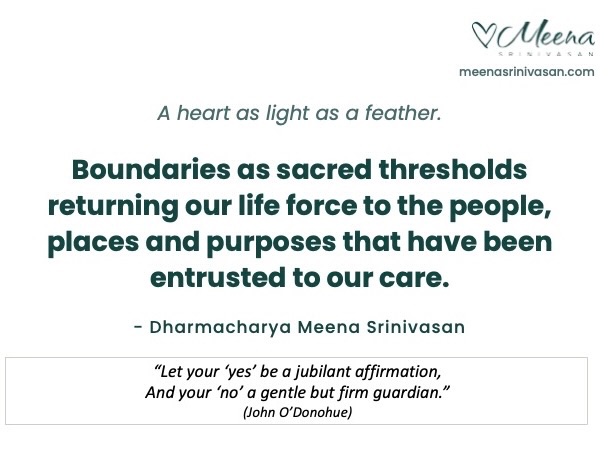
Let your “yes” be a jubilant affirmation,
And your “no” a gentle but firm guardian.
That is exactly the kind of boundary I am trying to practice now. Not hard. Not punitive. Not armored. A boundary that protects what is sacred while keeping the heart open. A place of discernment between what I encounter and what I take in. Between what I love and what I am responsible for. Between what needs tending and what has actually been entrusted to my tending.
Perhaps the deepest boundary is this: the boundary between what I can see and what I am called to carry.
During the past few years, I began writing about boundaries as bridges rather than walls. I still believe that. A sacred boundary does not have to exile another person from our heart. Sometimes the boundary is precisely what allows love to remain.
I can love you and not take this on. I can belong here and not participate in what creates dissonance in my body. I can care deeply about what happens and allow others to carry it. I can see that something needs attention without deciding that attention must come from me. I can say no without making anyone wrong. And while singing along to a little Hall & Oates playing somewhere in the background: I can’t go for that. No can do, I can do this all with lightness.
There is surprising tenderness in becoming able to say this without resentment, because the no is protecting a deeper yes. Yes to my child. Yes to my marriage. Yes to accompanying my parents with love rather than depletion. Yes to my practice. Yes to the work that is truly mine. Yes to the relationships and communities where my participation nourishes life.
Everything cannot receive the same portion of me. And increasingly, I do not believe everything is supposed to.
So this September, I am sitting with a few questions: What am I carrying simply because I noticed it? Where has caring quietly become an obligation? What am I capable of doing that I am not actually called to do? What might I need to walk out of so that I can more wholeheartedly walk toward what is mine to tend? And what deeper yes is asking for the protection of my no?
May our boundaries become sacred thresholds that return our life force, again and again, to the people, places and purposes that have truly been entrusted to our care.
May they make us not harder, but lighter.
From my heart to yours,
Meena
The Thich Nhat Hanh School of Interbeing is Open!
A Revolutionary Approach Education
After more than two years of dreaming, planning, building, fundraising, and tending, the school is alive with children, teachers, families, and so much love. Watch our Opening Ceremony from last Friday below (you can catch my remarks at the 1hr 3 min mark)! My son Kailash is loving school, and it brings me such joy as a parent to witness this vision taking root in his daily life.
On September 18, the School community and Plum Village monastics will gather online with friends from around the world to celebrate this opening and to hold the dream of a new kind of education for our children. We’ll share updates from the School, offer wishes for this new beginning, and reflect together on our hopes for children, education, and our Earth. The gathering is open to all, and I would love for you to join us in this moment of community, celebration, and possibility.
Join and Support the School of Interbeing!
We are a proud School of Interbeing Family

A Quote Card on Boundaries
Print this for a sacred reminder!


Meena's Newsletter
Offerings & insights from my heart to yours - delivered straight to your inbox.
Sign Up

