
Negative Peace vs. True Peace
Negative peace isn’t peace
At a time when the world feels on edge, I find myself reflecting on how we meet tension, both out there and in our own lives.
A few weeks ago, Kailash came home from school and told me about a lesson his teacher offered. There has been some name calling and hurtful behavior in his second grade class, and so they are learning the difference between tattling and truth-telling. Tattling, he told me, is telling on someone to get them in trouble and get attention. Truth-telling is when you go with the person, toward resolution, together.
I haven’t been able to stop thinking about this, because I’m realizing how much of adult life is still asking us to learn this same lesson.
There’s a quote I keep returning to from Malidoma Somé: “Conflict is the spirit of a relationship asking itself to deepen. And yet, when conflict arises, so many of us rush to fix, to smooth, to restore something that looks like harmony, or we “tattle” instead of truth-tell.
Thich Nhat Hanh’s teachings invite us to look deeply in order to transform anything. He also reminds us that peace must be cultivated within, even in the midst of injustice, and that this inner peace is not separate from social transformation, but a foundation for it.
And at the same time, I hold this with nuance. For me, this is the wise holding of both the ultimate and the relative dimensions. There is a place within us that can touch peace in any moment through practice, and there are also real conditions of harm, inequity, and suffering that must be named and transformed.
Inner peace alone is not enough if it becomes a way of bypassing what is real. And yet, without inner grounding, our efforts toward justice can lose clarity, steadiness, and compassion.
So the invitation, as I understand it, is to hold both. To cultivate peace within while staying fully present to the truth of what is happening around us, allowing our practice to deepen our capacity to engage rather than retreat.
This is the tension I am learning to live inside. And Dr. King names this so clearly.
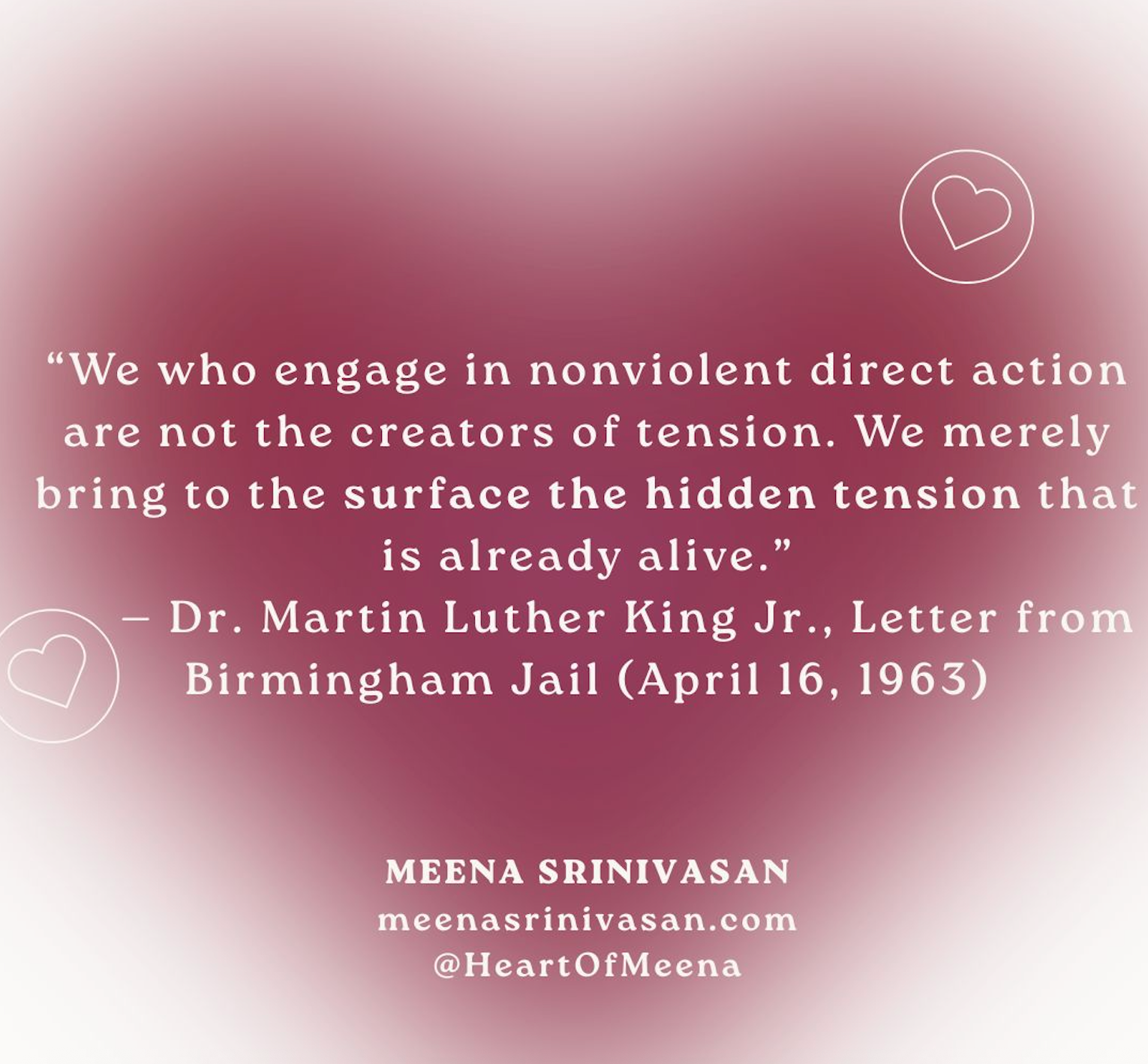
He warned us about what he called negative peace, the absence of tension rather than the presence of justice. A kind of quiet that asks us to swallow what is real. A kind of harmony that costs someone their truth.
I’ve been sitting inside this tension in my own life, in moments that have asked me to do exactly that. In a recent experience where racial dynamics were present, something that could have been held through truth-telling was instead taken elsewhere, and I was, in effect, “tattled” on. That was painful, and it illuminated how dominant culture and harmful power dynamics were moving beneath the surface, particularly in how one perspective was centered, without equal space or care given to understanding mine.
And as I continue to sit with it, something else is also becoming visible.
When I look deeply, I can see that the “tattling” likely came from fear, discomfort, and not yet having the capacity to receive what was being offered, an invitation to really examine race, power and privilege, so that a real relationship could exist between us.
I also recognize that for many people, especially those who have not regularly received an invitation to look deeply at unexamined privilege, direct feedback can feel like a call-out, and can simply be too much to hold. And that matters, too.
Over time, I’ve had to build my own discomfort resilience. I’ve been called out, called in, misunderstood, and even canceled. And I’ve also been unconscious. I’ve caused harm. This path has asked me to learn how to stay present when something in me wants to defend, shut down, or run. Not perfectly, but with practice and in Transformative Educational Leadership (TEL) we now do our best to call forward in order to build a future we can love.
And love, I am learning, does not mean bypassing what is real.
There are places in my life right now where I am not ready to reconcile, where hurt remains and trust has been impacted. I am practicing letting that be true, even if it is perceived as “spiritually immature.” Taking care of my anger is to become intimate with the heartbreak and love beneath it, rooted in my unwavering commitment to justice and belonging. It's painful for that commitment to be reduced to or critiqued as "attachment to view." It feels like a kind of bypass that allows us to diminish lived experience rather than remain present long enough for deeper understanding to emerge.
Because I am remembering something that feels like a deep dharma teaching to me: when we rush to repair without first looking deeply, we risk putting whipped cream on shit. It may look like harmony, but underneath, the truth remains untouched.
So I am practicing something different, letting there be space, tending to my own heart, and allowing the tension to be constructive.
Reconciliation, I am learning, does not begin out there. It begins within. It begins with telling the truth about what we feel, without bypassing pain, and with tending to our own hearts so that whatever comes next is rooted in the conditions for true healing, transformation and Beloved Community.
Tenderness is not about rushing to repair. It’s about staying present long enough for something real to emerge, even when that is uncomfortable, even when it asks us to sit in the in-between.
And I’ve been reflecting on something else. Sixteen years ago, in India, when I was ordained into the Order of Interbeing, I received my dharma name: True Seal of Peace.
If I’m honest, at the time, I wasn’t feeling the name. I didn’t understand why I had been given it. But over the years I’ve begun to understand that these names are not descriptions of who we already are. They are compasses. They are invitations to who we are meant to become.
And what I am seeing now is this:
Peace is not the absence of tension.
It is not avoiding discomfort.
It is not smoothing things over.
True peace asks for truth.
It asks for the courage to look deeply.
It asks for the willingness to stay.
Even when it’s hard.
Especially when it’s hard.
I continue to believe deeply in Beloved Community. I see the goodness and aspiration, even in those who may be unconscious when it comes to race, power, privilege, and the systems that shape us. And I also see how much capacity it asks of us to stay present to truth, especially when that truth is uncomfortable.
This is not easy work. It is slow work. I’m reminded again and again that this is long-view work, something we build slowly, with care, over time. There are moments when it can feel thankless.
And yet, it is not.
Again and again, I’m invited to remember the gratitude and the privilege of being alive in this moment, to participate in this work, in these complex and remarkable times. So many throughout history have carried work like this without recognition, and that, too, is part of the path. This work matters, even when it is unseen. It is shaping something larger than any single moment of acknowledgment.
So perhaps the invitation for all of us right now is this:
- Where in your life are you being asked to look deeply?
- Where might you be moving too quickly toward harmony?
- And what might become possible if you allowed the tension to teach you something first?
The practice continues. Always.

P.S. Right now the soundtrack of my soul, what's holding me as I tend to my heart are the sacred songs of Jahnavi Harrison. If you are longing for a balm for your spirit check her music out. Some of my favorites here, and I'm transitioning off of Spotify so if you have good alternatives that better support artists, let me know!
Join us for the Rhythm of the Earth music festival at Deer Park. It’s one of my favorite annual gatherings at the monastery, a day to be in nature, listen to music, and feel a sense of connection and presence with others. Chihiro is on the organizing team this year!
If you are local to Southern California or planning a visit to the area in May, join us in person. If you cannot make it, you can still be part of it through the livestream.
All proceeds support the Thich Nhat Hanh School of Interbeing, which makes it even more meaningful for our family.

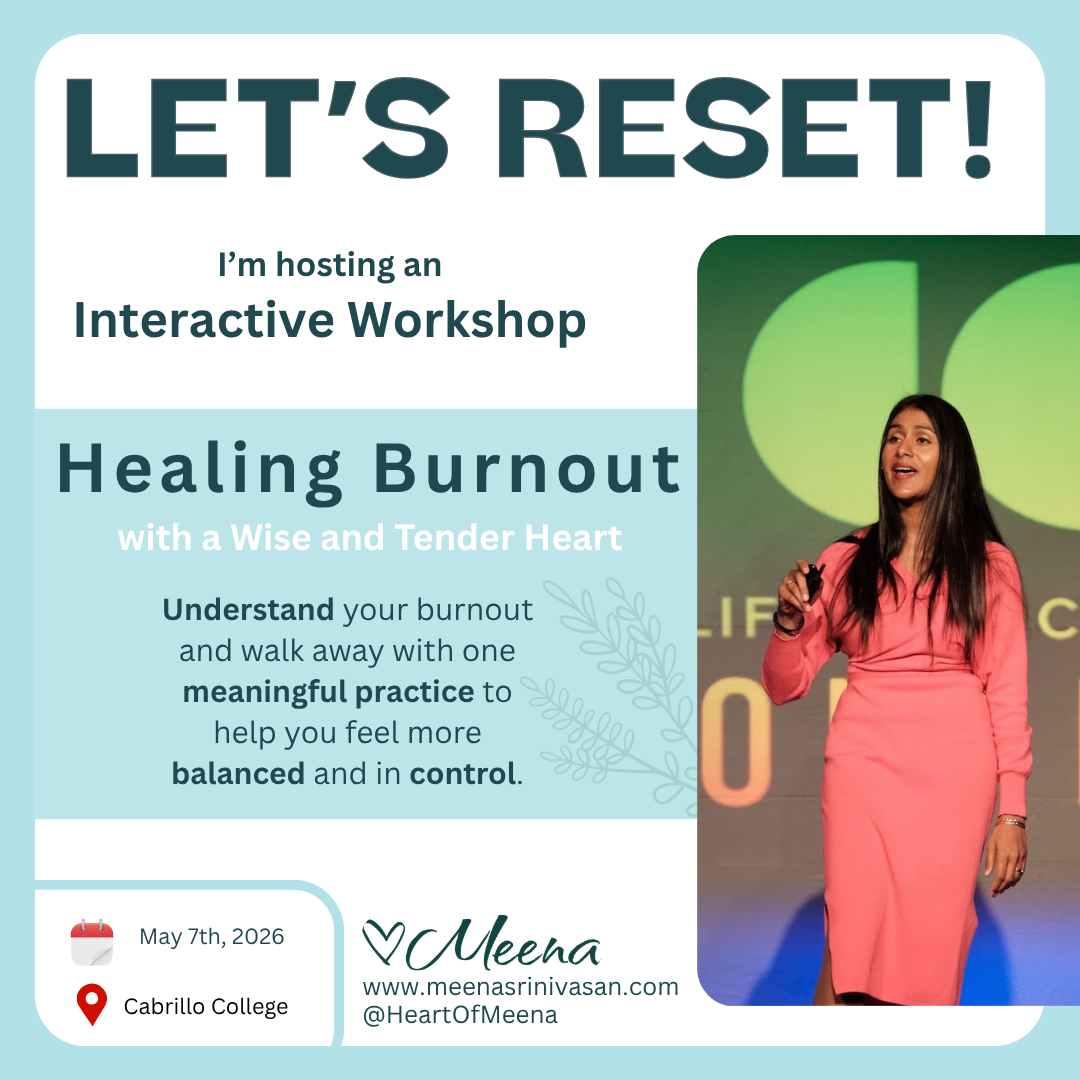
I’m in a very full season of life, and I’ve been reflecting on what keeps me from burning out. There are two things. The beloved TEL community, leaders walking this path with courage and heart. And my global sangha, who are there in any moment across geography, alongside the powerful ancestral presences holding me across time and space. And beneath both, a deep connection to purpose that calls forth a will and capacity to keep showing up for what I believe in. As David Whyte writes, burnout is a loss of connection to the inner fire that once sustained us. My fire is still very alive, and community and purpose keep it lit.


Meena's Newsletter
Offerings & insights from my heart to yours - delivered straight to your inbox.
Sign Up

